Foreword
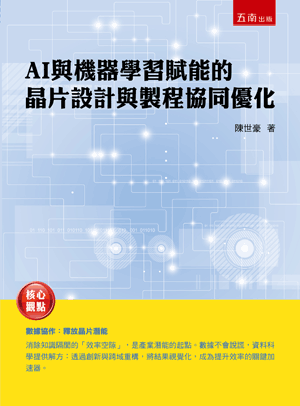
AI-Driven Semiconductor Chip Design Efficiency and Productivity Revolution
Part I: Design Technology Co-Optimization, DTCO
Chapter 1 Overview and Evolution of DTCO
1.1 Principles of Design for Productivity
1.2 Design Methodology for Ultimate Efficiency
1.3 Future Directions of DTCO
Chapter 2 Key Challenges and Strategies in Driving DTCO
2.1 Key Challenges in Implementing DTCO
2.2 Demand for Innovative Design Methods
2.3 Productivity Optimization Platform Development
Chapter 3 Optimizing Chip Energy Efficiency and Productivity
3.1 Preparatory Work Before Project Initiation
3.2 Custom Cell and Timing Signoff Strategy
3.3 Process Optimization and Analysis Techniques
3.4 Compensation Mechanism Design and Implementation
3.5 Challenges and Demands of Near-Threshold Voltage Technology
Part II: DTCO.ML ™ : Machine Learning-Driven Semiconductor Process Optimization
Chapter 4 The Integration of Machine Learning and DTCO (DTCO.ML ™ )
4.1 Virtual Wafer Data Modeling (Virtual Silicon)
4.2 Building and Inferring Regression Models
4.3 Application of Data Tracking and Production Optimization
Chapter 5 Library Metric Extraction and Analysis System (libMetric ™ )
5.1 Cell Timing and Power Modeling
5.2 Cell Feature Extraction
5.3 RO Simulation
5.4 Standard Cell Library Batch PPA Benchmarking
Chapter 6 On-Chip Sensor Design and Integration (GRO Compiler)
6.1 Goal-Oriented RO Design
6.2 SPICE-to-Silicon Correlation
6.3 Process Monitoring and Optimization
6.4 On-Chip Effective Voltage Analysis
6.4.1 Local Voltage Distribution Monitoring
6.4.2 Compensation Strategy
6.4.3 Dynamic Timing Slack Alerts and Layout
6.5 GRO Automation Tool and Verification Process
Chapter 7 Data Analysis and Machine Learning Platform (Copernic ™ )
7.1 Data Standardization and Visualization
7.2 Cross-Domain Mapping of Multi-Dimensional Data
7.3 Design Flow Integration Strategy
7.3.1 WAT-aware Timing Re-K
7.3.2 WAT-CP Mapping and Correlation Analysis
7.3.3 OCV Analysis
7.4 OCV Analysis and Design Margin Optimization
7.5 Post-Silicon Analysis and Optimization
Chapter 8 Chip Performance Rating Strategy and Optimization (Binning-PG ™ )
8.1 Impact of Binning Strategy on Productivity
8.2 Chip Characteristics Analysis and Challenges
8.3 Binning Policy Generation (Binning-PG ™ )
8.4 Automated Policy Generation and Optimization
8.5 On-chip Self-binning Application
Part III: DTCO.GenAI ™ : Generative AI-Driven Chip Design Innovation
Chapter 9 Generative AI and DTCO Integration (DTCO.GenAI ™ )
9.1 Limitations of Traditional Modeling Methods
9.2 Following the Trail: Multivariate Normal Distribution
9.3 Virtual Silicon Data in DTCO (DTCO.VS)
Chapter 10 Virtual Silicon Data Generation Technology (DTCO.VS)
10.1 Dataset Preparation
10.2 GAN-based Virtual Silicon (GAN-VS)
10.2.1 GAN Model
10.2.2 GAN Model Performance Evaluation
10.3 Diffusion Model-based Virtual Silicon (DM-VS)
10.3.1 Denoising Diffusion Probabilistic Model (DDPM))
10.3.2 Diffusion Model Performance Evaluation
Chapter 11 Generative AI-Driven Chip Efficiency Optimization and Modeling
11.1 WAT Super Resolution (WAT-SR)
11.2 High-Efficiency SPICE-Silicon Bias Modeling (He-SSBM)
11.2.1 Design Principle of One-shot SPICE-Silicon N/P Correlation
11.2.2 Design and Signoff Strategy Optimization
11.3 High-Fidelity Generative Monte Approximation (HΣ- GMA)
11.3.1 Limitations of Traditional Monte Carlo Methods
11.3.2 Innovative Application of Generative Neural Networks
Chapter 12 Conclusion and Outlook
12.1 AI-Enhanced DTCO: Revolutionizing Chip Design and Process Optimization (DTCO.ML ™ )
12.2 Generative AI-Driven Optimization (DTCO.GenAI ™ )
12.3 EDA Innovation and Future Outlook
Appendix
Open Source Resource List
Reference List
Glossary of Terms